
Separate but Connected: How a Passive Letter Writing Station Became Its Own Therapeutic Space
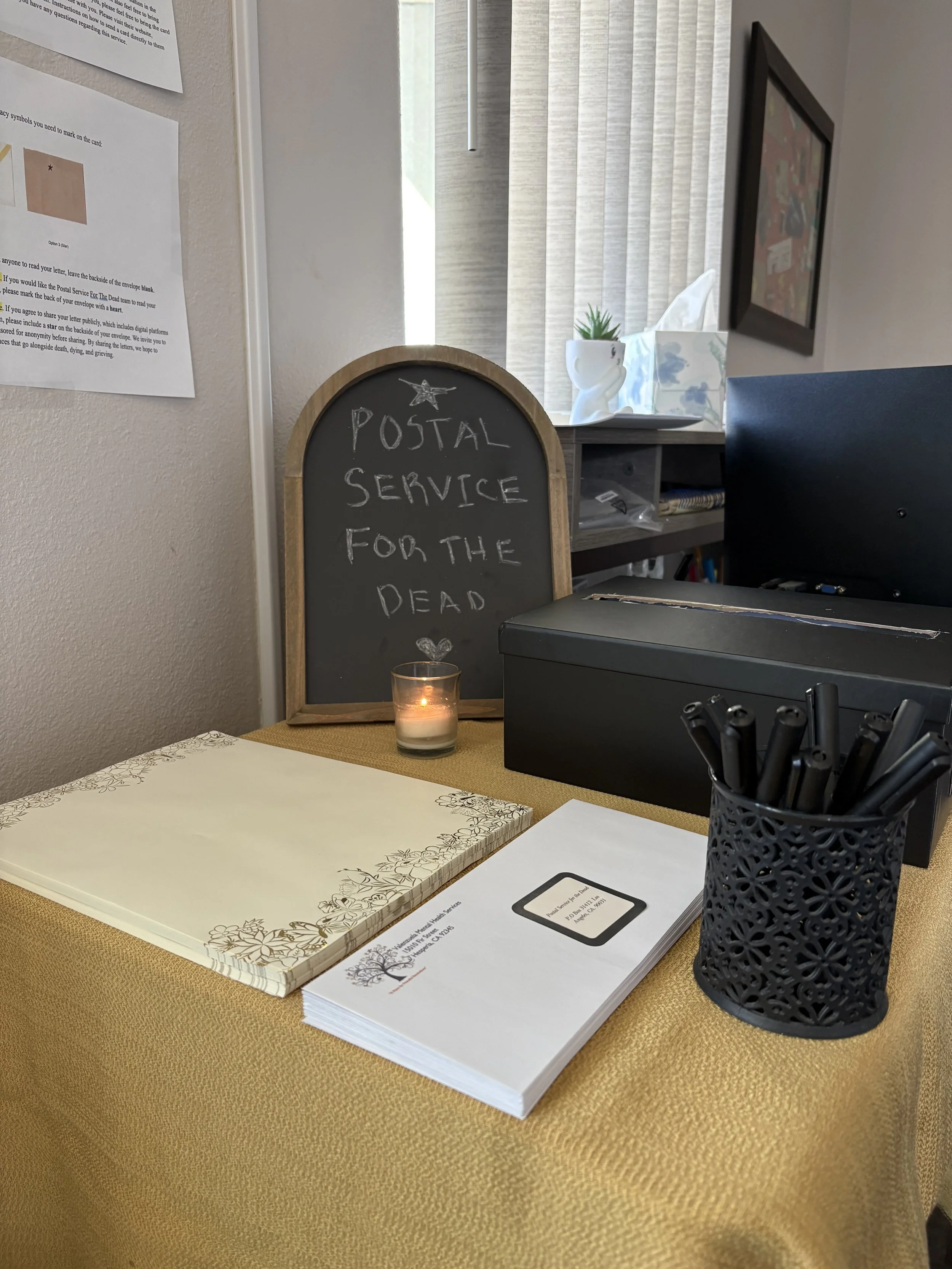
Passive station set-up with pens and stationary
Quick Note
A note from Janelle, Founder of Postal Service for the Dead: We often get questions of how folks can bring Postal Service for the Dead to their community. In addition to our blog post about organizing a letter writing party, below is an example from Adela Valenzuela who is currently a Master of Library and Information Science (MLIS) student at University of California Los Angeles (UCLA). In the Spring of 2026, Adela was part of a small group of graduate students who collaborated with Postal Service for the Dead to get hands-on working experience in a community archive. You can learn more about their experience here and at the end of the article you can find helpful resources for hosting your own event.
Project Overview
Over the course of three weeks, I hosted a passive Postal Service for the Dead station at a mental health clinic. The station offered clients the opportunity to write letters to loved ones who have died, creating a quiet space for reflection, remembrance, and connection. By providing an opportunity to write, reflect, and symbolically send a message to someone who is no longer here, the station created a path for healing that felt deeply personal to each participant. It served as a reminder that grief takes many forms and that meaningful support can sometimes emerge through quiet rituals that invite connection, memory, and hope.
What is a Passive Station?
A passive station is typically a workstation where materials and instructions are provided so that participants can engage independently, without the presence of a facilitator. Participants can choose to engage with the station whenever they feel comfortable, making it a flexible and low-pressure form of community engagement.
Below is an example of the passive station I created for the mental health clinic. The lobby was small, so I kept the station small as well. Materials were provided and instructions were posted on the wall. If clients had any questions, the receptionists were able to provide further explanation. Printed out instructions were also provided if the client wished to write letters at home.
Preparation Process
Because the clinic serves a diverse population ranging from children to seniors, it was important to provide clear information about the passive station, how participants could engage with it, and the mission behind Postal Service For The Dead. This preparation was not only beneficial for clients, but also for clinic staff, who could then answer questions and support those interested in participating.
To make the station as accessible as possible, I created an informational flyer that explained the purpose of the project, outlined the letter-writing process, and provided instructions for submitting letters from home. This was especially important for clients who receive services exclusively through telehealth appointments and may never visit the clinic in person. The clinic also serves a large Spanish speaking population, so the flyer was also translated into Spanish. By offering multiple ways to participate, the project was able to reach a broader audience and ensure that anyone interested in connecting with the experience had the opportunity to do so.
Unexpected Insights
What emerged from this experience was both moving and unexpected. Although the station was located within the clinic, many participants appeared to engage with the letter-writing process as a distinct experience from the clinical services being offered around them. Rather than utilizing the mental health resources available in the space such as taking the letter into their sessions or asking for support via Telehealth, clients gravitated toward the station and service as a personal therapeutic tool, one that allowed them to process grief privately and on their own terms. The act of writing a letter provided an alternative avenue for expression. For some, it may have seemed easier to address unresolved feelings, memories, or questions directly to a deceased loved one than to discuss them in a traditional therapeutic setting. The letters became a form of self-guided reflection, allowing participants to engage with loss in a way that felt meaning and accessible.
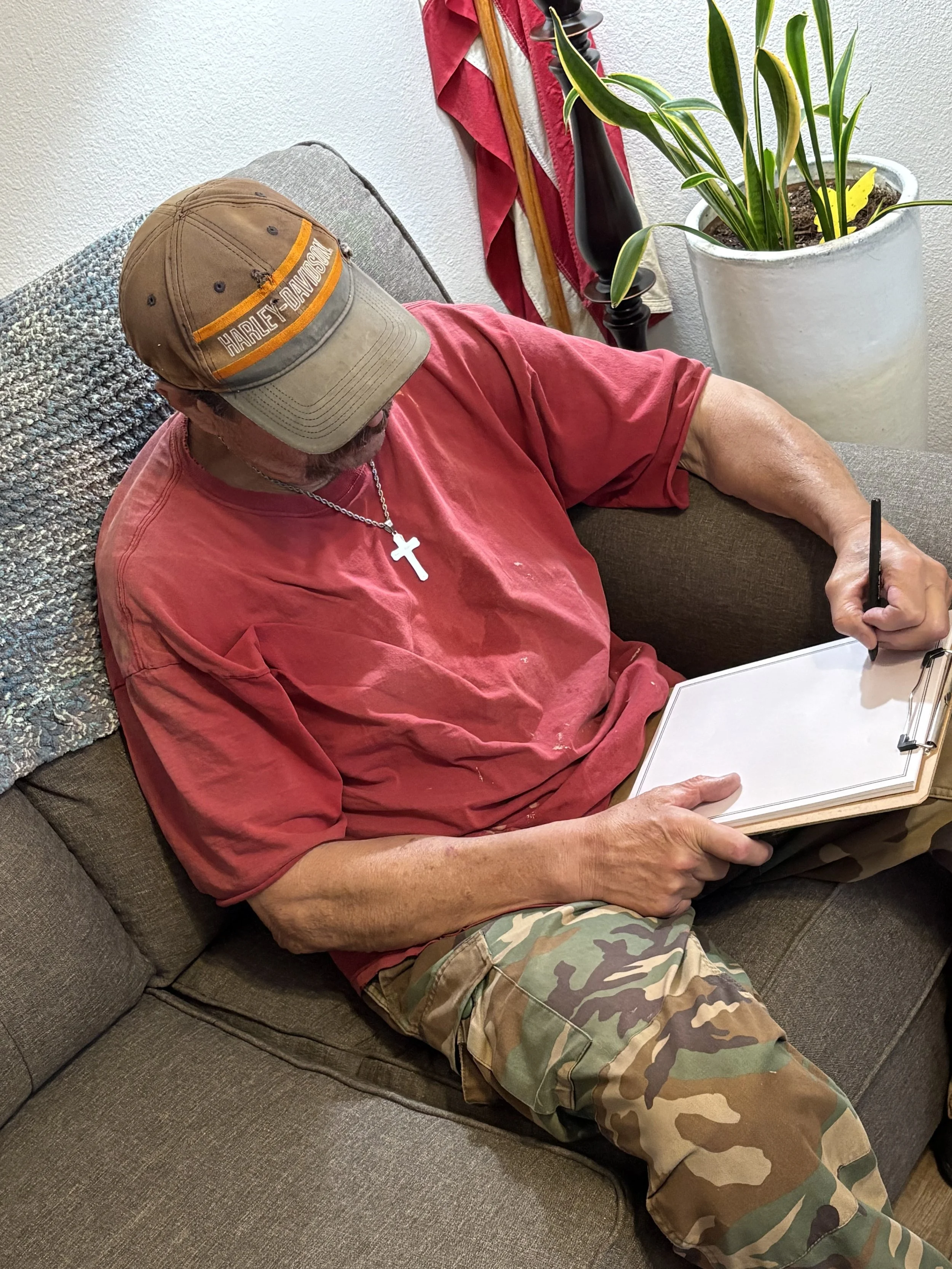
Participant writing a letter
Another notable observation was that every participant selected the star delivery option. While Postal Service For The Dead offers several privacy delivery methods, the universal choice of the star suggested a shared desire and connection through another community beyond their physical mental health setting. The separation the clients created between the passive station and the clinic itself was a moving experience. Although both existed within the same environment, the letter-writing station functioned as its own space, one that encouraged personal agency and reflection without the structure typically associated with mental health services. This highlights how creative and ritual-based approaches to grief can complement, but also operate independently from, traditional therapeutic frameworks.
“Connecting our clients with Postal Service For The Dead through this passive station showed us how our clients have thought about people from their past who are no longer with them, the lost opportunities they still held such as final good-byes, or emotional expression either negative or positive, and the realization that they can complete these unresolved issues through another therapeutic instrument such as sending a letter.”
- Valenzuela Mental Health Services
Resources
How to Send a Letter Instructions (2-Up Half Sheet)
Passive Station Flyer Template - please copy and edit highlighted areas